


Electron density and chemical forces
The method of Deformed Atoms in Molecules (DAM) proceeds in two steps.
First, the whole density of the molecule is partitioned into atomic
contributions (that will be called pseudoatomic densities) following two
partition criteria:
- These contributions must retrieve the total density upon summation.
- The shape of every atomic contribution must be as spherical as possible.
Once the pseudoatomic densities have been determined in a given system, the second step consists in the expansion of every atomic contribution in regular harmonics times radial factors centered in the corresponding nucleus. This process yields the molecular density as:

(1)
Where
 ,
,
 , label the nuclei, and
 ,
,
 ,
,
 ,
,
 , label the subsets of the basis functions,
 ,
,
 , ... centered respectively at
 ,
,
 ,...; and
 ,
,
 . The regular spherical armonics is defined as:
(2)
Where
 are the associated Legendre functions.
 The radial factors,
 , are accurately computed and fitted to piecewise analytical functions.
DAM carries out this process in a very efficient way for Slater (DAM program) and Gaussian (G-DAM) functions.
, are accurately computed and fitted to piecewise analytical functions.
DAM carries out this process in a very efficient way for Slater (DAM program) and Gaussian (G-DAM) functions.A simple and very enlightening example based on the partition of the electron density of H2 can be accessed clicking here.
This representation of the density gives a very detailed description of how density is arranged around each nucleus, which can be visualized, for instance, by depicting contour lines for every single term of the expansion. In this respect, it is important to recall that these expansions are, by construction, very rapidly convergent, so that plots of succesive terms may require very different contour values to be visible. Thus, spherical terms
 are, without any exception, very much larger than terms corresponding to deformations.
 Even, among these latter, dipole
 and quadrupole
 are of the same order of magnitude and, usually, considerably larger than the following terms in the expansion (octapoles, hexadecapoles, ...), which can be neglected in many cases. The following pictures illustrate the contour lines in the molecular plane for the first terms of the atomic expansions in ethylene.

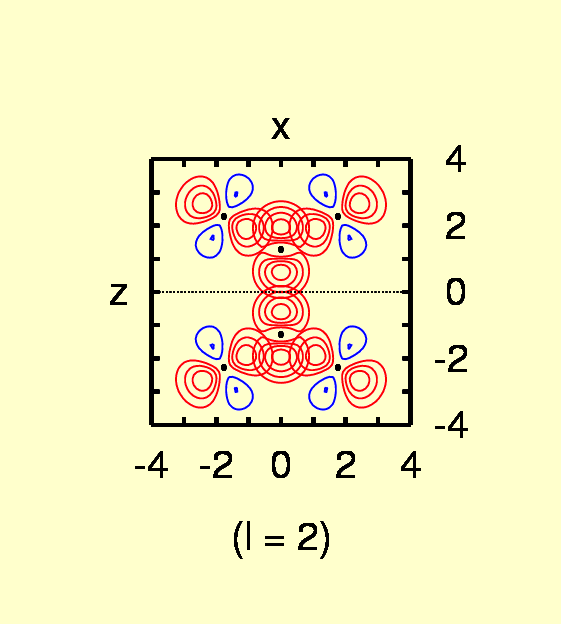
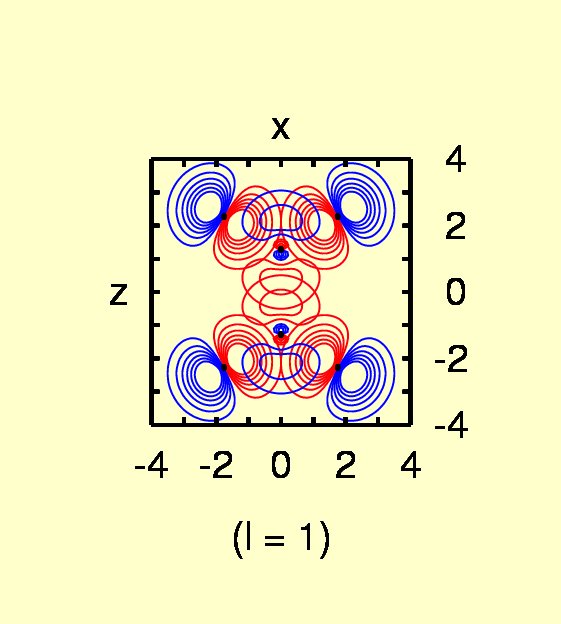
(Contours: for l = 0, from 0.05 to 0.4 in steps of 0.05; l = 1, from -0.03 to 0.03 in steps of 0.005; l = 2, from -0.03 to 0.03 in steps of 0.005 for C, from -0.0025 to 0.0075 in steps of 0.0025 for H)
The convergence of the expansion can be examined by comparing the contour lines of the exact density with those corresponding to succesive truncations. Usually, truncation at
 is sufficient to reach an accuracy of four decimal places in the whole density. Nonetheless, both DAM and G-DAM programs are prepared to work with expansions up to.
 The whole density, atomic densities and every component of their representations can be visualized by depicting their constant value contour surfaces in physical space.
 Moreover, drawing together several of these surfaces, one can obtain very complete and meaningful pictures of the electronic cloud or its components. In this way,
it is very illustrative to compare the pictures of the whole molecular density with the summation of the spherical terms of the atomic densities. In the following figures,
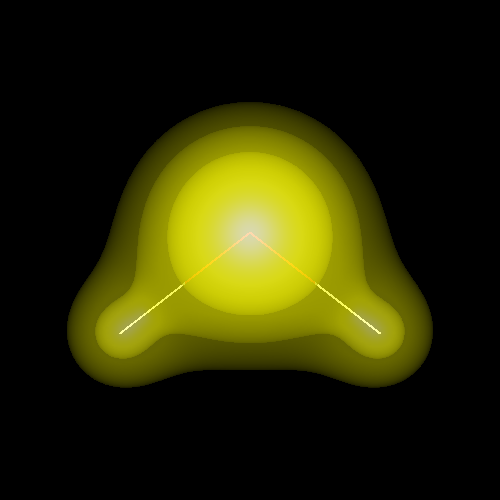
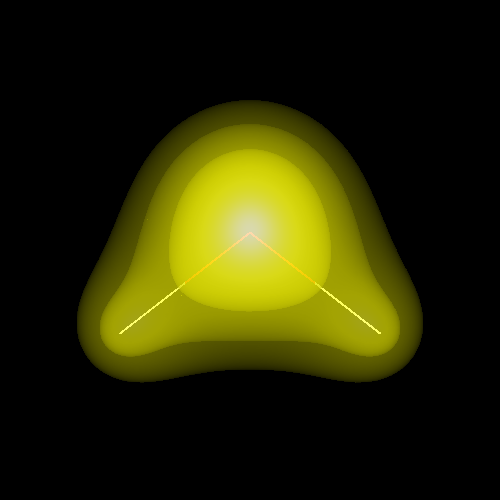
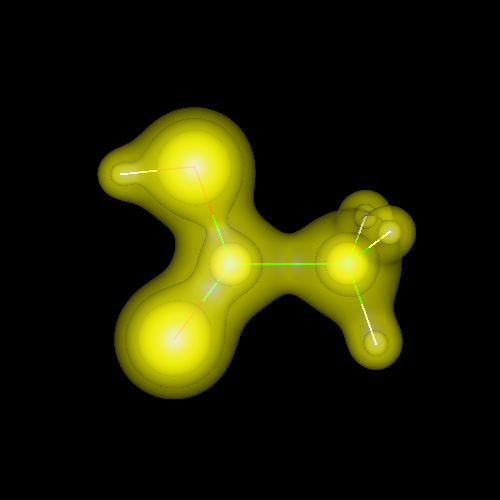
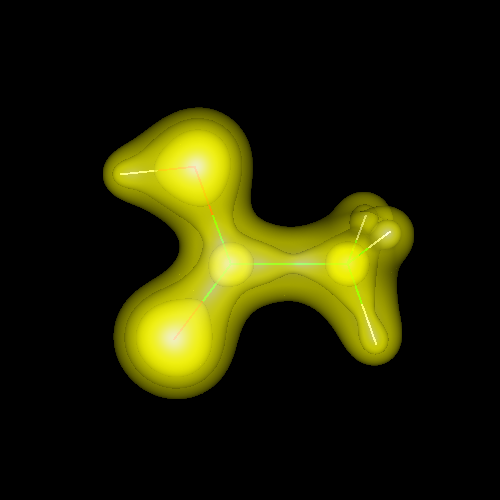
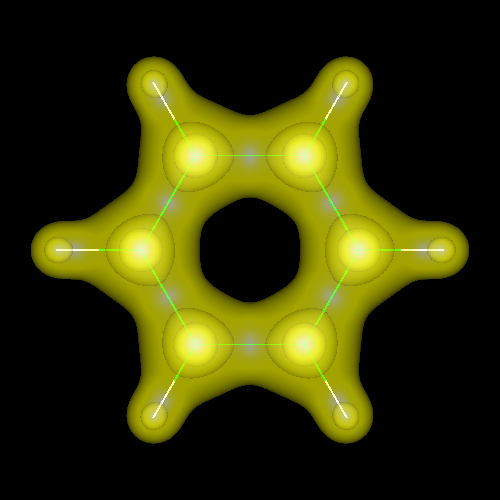
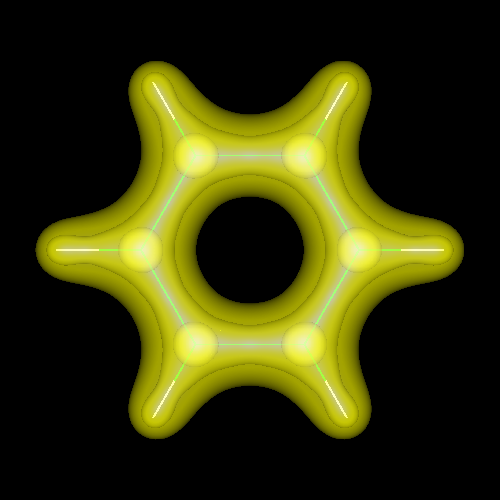
the full electon density (left plates) and the sum of spherical terms (right plates) are depicted for water, acetic acid, benzene and diborane:
Moreover, drawing together several of these surfaces, one can obtain very complete and meaningful pictures of the electronic cloud or its components. In this way,
it is very illustrative to compare the pictures of the whole molecular density with the summation of the spherical terms of the atomic densities. In the following figures,
the full electon density (left plates) and the sum of spherical terms (right plates) are depicted for water, acetic acid, benzene and diborane:
Figures to be updated with the DAMQT 3 viewer density images.
Water
Acetic acid
Benzene
Diborane


As it can be seen in these examples, the close similarity between these two types of pictures shows again that the molecular density is largely dominated by the spherical parts of its constituent atoms.
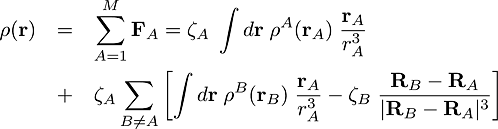
Let us comment now the consequences of the application of the electrostatic theorem in this context. As it has been mentioned above, the theorem states that the force acting on a nucleus is equal to the electrostatic force exerted on it by the electron cloud and by the other nuclei. With the molecular cloud partitioned into atomic contributions, the electrostatic force on the nucleus can be written as:
(3)
The first contribution is the self-pulling force, namely, the force exerted on a nucleus
by its own cloud. The second term is the external force, exerted by the clouds and nuclei of the remaining atoms.
In this line of thought, it is essential to know how these contributions are affected by the spherical, dipole, and succesive terms of the atomic expansions.In case of the self-pulling force, symmetry considerations are sufficient to see that the only term in the expansion of
 giving a non-vanishing contribution is the dipole term
. In case of the external force, all expansion terms of any
giving a non-vanishing contribution is the dipole term
. In case of the external force, all expansion terms of any
 do contribute, the point here being their magnitude. As stressed above, spherical terms of the
density are largely dominant, and in consequence the external force on a given nucleus will be mainly determined by the balance between the forces generated by the nuclei and spherical clouds of the remaining atoms.
do contribute, the point here being their magnitude. As stressed above, spherical terms of the
density are largely dominant, and in consequence the external force on a given nucleus will be mainly determined by the balance between the forces generated by the nuclei and spherical clouds of the remaining atoms.Neglecting the effects of the small deformation terms, one can write:

(4)
where the effective charges,
 , are given by the Gauss theorem:
(5)
with
 .
. The second term in eq(5) is part of the electron charge associated to the cloud of atom
and therefore, in neutral atoms or in cations, the net effect of external forces
is repulsive. For anions, this effect is attractive at long distances but changes to repulsive at short ones.It is very illustrative to consider how the forces between a pair of atoms or ions strictly spherical would be. In this case, the self-pulling force is obviously zero and only external forces remain. As proved before, these forces are repulsive for couples of neutral atoms, an atom and a cation or pairs of cations. In case of a system consisting in a cation (or a neutral atom) and an anion, the force on the anion nucleus will be always repulsive (at all distances) whereas the force on the cation nucleus will be attractive at long distances and repulsive at short ones. Note that none of these couples can conform a stable system. In order to form a stable system, densities cannot have spherical symmetry. In other words, density deformations are essential for the appearance of attractive forces.